Thursday, December 8, 2011

week 15 - Video Essay Reflection behind the scenes
I love making films; I have love editing clips into random videos, of crazy or interesting stuff. This project turned out to be a huge struggle due to a lack of adequate technology. In the past I was lucky enough to have access to adobe premier though my school which allows a huge advantage in editing options. I do enjoy projects like this but I did wait till the last minute, and I was on the retreat all weekend so feel like I was not able to put my full effort into the video.
However the process and idea behind the project is superb, I wish I could have more final projects like that. It was really interesting to see what people learned and gained from this class. I feel like I could have expanded more on the topic had it been something more like “the most fascinating aspect of this class was…”, not because I didn’t like the topic that was given, rather I felt like my experience in the class was one of review. I feel that had this class been my first exposition of the synoptic characteristics of the Gospels it would have been very life changing. I do remember what it felt like to learn that most of Jesus’ followers immediately believed him to be more humanistic and more of a teacher. I was surprised to learn the historical context of Jesus’ life. He was not the only man attempting to reform Judaism and call people to love. He was present among man self proclaimed prophets and teachers who held similar convictions, as well as some other radical ones.
I did learn from this class that there was a larger population of Jesus scholars who did not belong to the Fundamentalist movement; scholars who had actually attended prestigious universities. I knew of a few in the past I’ve read a book by a Jesuit scholar, Pierre Tielhard de Chardin, who did his work to rectify religion and the evolution of Humanity. I have also read the work of Karen Armstrong her recent book titled “The Case for God” in her novel she discussed much of the early life and evidence for the historical Jesus. Shortly after she dove into the metaphysical and faith based ideas surrounding faith life.
My video project was interesting because I had to choose an aspect of the class that didn’t truly stem from the content of the class but rather the arrangement of the assignments. It was very unconventional and I liked it. I admit some weeks the thought of a blog post made me cringe, however some weeks I feel that I could pour out ideas into my blogs. I was largely dependent on how I was feeling that week. Unfortunately my Video essay did not come around at a good time for me. However I still feel like I was able to turn a good result despite the complications.
Thursday, December 1, 2011
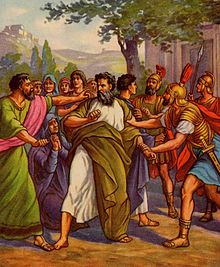
Week 14 - The Martyrdom of Paul
According to Marcus Borge’s the first Paul, Paul’s death is surrounded by uncertainty. As stated by Borge the writer of Luke and Acts did not want and both of his books with a roman condemnation. Judging by this fact and this fact alone it serves to follow that a book of acts would not end with the death Paul. The roman Emperor Nero was in power at the time of the Paul’s death and it was overwhelmingly likely that Paul suffered a death similar that of many Christians at the time. Emperor Nero used the Christians as a scapegoat for a mighty fire that destroyed nearly half of Rome. History proves that Nero started the fire to begin with in fact it was a ploy to rally anti Christian support underneath him. After this fire Nero went on a rampage massacring hundreds of Christians; yet they continued to survive.
I find that is quite Remarkable that finally after the Romans finished persecuting the Jews the Focus then shifts to the Christians. This actually leads me to understand that the beliefs of the religion had nothing to do with the executions and persecutions of the Jews or the Christians, but the power and Unity that the religions aroused in their peoples.
Christianity has Paul to thank for that. Through walls efforts to Christian expanded throughout the entirety of Europe. Paul’s Missions stretched all away from Spain back to Rome and even parts of Jerusalem. It can be understood that because of his widespread conversions by single man to Christianity in Europe and the Middle East was able to thrive under similar ideas. This created a unity among all Christians whether not they realized it. And thus when Nero began to persecute and execute Christians; no amount of propaganda physical violence, or threats could halt movement.
In many of Saint Paul’s letters, there is differing evidence concerning the location and manner of his death. The most common image that we think of is near a summoning Paul to have him be headed. However it is far more likely that Paul was just another death among the many Christians who died under Nero's reign.
I find it really interesting that Paul’s death was not separated from that of many other Christians. Because his death is not separated Paul; is put on the same level as any other Christian martyr. Because of this to communities that Paul established are able to better identify with Paul, as well as many communities after that. To this day and Christians can identify more with Paul than they can with Jesus because he is more human.
Thursday, November 10, 2011
Week 11 -- Heightening Christology: Jesus Model of Living to Lord and Savior
According to the recent lectures and knowledge amassed from my Catholic high school education; Jesus’ persona became more and more divine as the years after his death progressed.
This conjecture (ooh big word) makes all the more sense to me as I contemplate it. Automatically I think of other various religions I have studied in my comparative religions courses. During those classes I noticed often that the originators of many religions began as normal people surrounded by extraordinary circumstances. Yet as the literature that surrounds their deeds grows more distant the deeds and the person them self seem all the more extraordinary.
I’ve read of many examples of this phenomena, for example the Siddhartha Buddha, he never claimed to be anything more than human, neither did his followers although they considered him in the highest regards and an enlightened human being. Yet in the years following his death subsequent followers became accustomed only with the oral tradition of his incredible wisdom and slowly his identity became detached from humanity and placed slightly above. This occurred in Buddhism to a slight degree but not so far as to place him on the level of a deity, something not condoned by the religion.
I certainly feel that this could apply to Jesus while I am not bringing into question his divine nature nor his noble mission or self sacrifice, I do feel that the tendency of people to elevate leader to uber-human levels still applies. The evidence lies (as discussed in class) within the Gospels, as we look back at the Chronology of the four Gospels, the Christology of Jesus certainly rises reaching the utmost height in John’s Post and even Pre- Easter Jesus.
In the case of Christianity the elevation of Christ come with a purpose, a purpose that grows as the religion of Christianity developed out of the “Jews For Jesus” movement as one of my high school teachers affectionately called the Jewish sect that held growing popularity of the disciples teachings.
Ultimately my point is simply that even if Jesus were a mere mortal, to put it in a cliché manner, I find that the development of his divinity make sense and does not come to a surprise that as years passed Jesus became viewed more God-like than the humble teacher that is described in Mark.
 ---->
---->Thursday, November 3, 2011
Week 10 Perceptions of God
Considering a Majority of my wiki group project focused on the various images of God throughout time, I thought it was interesting that in “The Color Purple” by Alice Walker, the Character Celie has trouble with her image of God. Celie can’t seem to get the “White Folk’s” God out of her mind. In most churches from the time they depict a very classic depiction of Jesus as the Aryan man with dark blonde hair and soft blue eyes. Only Celie has trouble with this interpretation, because she can’t identify with God or Jesus. In fact due to hard ship she feels the need to turn away from hardship because of like any other man Jesus and God weren’t there in her mind to help her through the sorrow filled years of her life. She humanizes God to the point of him being absolutely unreliable.
I can identify with her struggle to view God as more than human and feel the frustration that nearly every person experiences when hardship rears its head; whether its sorrow, loss, anger, or despair. Many of us feel abandoned by God. We lose hope. I know I have. However the excerpt provides a message of hope. In fact I recall the infamous “Footprints” prayer, where God assures the person that in during all the hard times when they only “saw one set of prints” as opposed to both the person’s and God’s, that God carried them. The prayer like the passage inspires hope, it lets us know that we are not alone; in the worst of times God is there to carry us through.
The passage has a more symbolic and colorful meaning behind it than simply God’s accompaniment, Shug contrasts Celia’s pessimistic view of God with her words. She describes a God who is always present (whether we choose to notice it or not), one that is ageless, genderless, fearless. She assigns God as an IT. An IT that doesn’t care if people don’t try to please IT. An IT that appreciates all the things people do to try and please IT. But most importantly an IT that just like everyone else wants to love and be loved.
The Core of Shug’s message being that people should stop trying to criticize all the prayers that go unanswered and things that go wrong, but simply stop and notice all the little thing that IT has already done for them. She provides the example of the color purple of the wildflowers that brighten the day as she walks past.
I find Shugs message to be an affirmation of my own beliefs and even more eloquent and hopefull description about God she claims that she “couldn’t find God in a Church” and I couldn’t agree more. Not to discount the mass however but to acknowledge that God’s presence exists in everyday life and that God is not a vengeful God but rather the loving IT that may have even had “hair like sheep’s wool”, an IT that just wants to be LOVED.
Friday, October 28, 2011
Immediate 2nd Coming??? (Imminent Echatology) week 9
No Christ did not return years after he left his disciples, but he left them with the impression that they should spread the good news as far as they could. they interpreted this message as a imminent need for Christs coming. Especially looking to the letters of Saint Paul and the acts of the apostles, it becomes clear that they beleived that Jesus would return to Judge the world in their own life times.
This beleif that Jesus would return is defined by Borg is Imminent Echatology, this led the Disciples on the fast paced attemps to convert and spread the good news to help as many people as they could before the second coming. each Gospel writer has its own interpretations of how soon Jesus would return. from Mark-to Matt- to Luke- to John, in that order the time that Jesu would return moves futher and further into the future.

This beleif that Jesus would return is defined by Borg is Imminent Echatology, this led the Disciples on the fast paced attemps to convert and spread the good news to help as many people as they could before the second coming. each Gospel writer has its own interpretations of how soon Jesus would return. from Mark-to Matt- to Luke- to John, in that order the time that Jesu would return moves futher and further into the future.
Subscribe to:
Comments (Atom)